
Your Poor Posture Is Killing Your Swing!
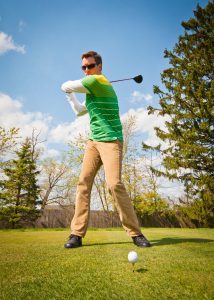
Posture is a buzzword in golf. Most people can recognize good vs. bad posture when they see it, but don’t know how to define or correct it.
Let’s define posture.
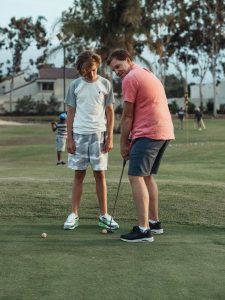
Posture is the position from which movement begins and ends. If your static (non-moving) posture is less than ideal, when movement begins, it typically deteriorates.
The poorer your posture, the more energy it takes to move the body. Therefore, improved postural alignment should be one of the cornerstones of any good athletic performance program.
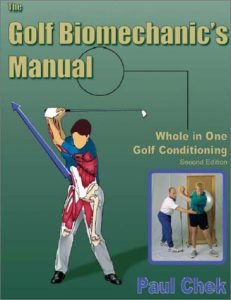
“Posture is not something you can just think about and expect to change. Improving posture is something that should be the foundation of every rehabilitative and conditioning program to improve function.” – Paul Chek, The Golf Biomechanic’s Manual

What Causes Poor Static Posture?


If you’re like most of the golfers I’ve worked with over the past 16 years, you sit for most of the day (anywhere from 8 to 12 hours) and have been doing so since you were 6 years old.
Inevitably, sitting too much will cause your static posture to deteriorate. Your shoulders will tend to round, your head will drift forward, and your mid-back will become excessively rounded and less mobile.
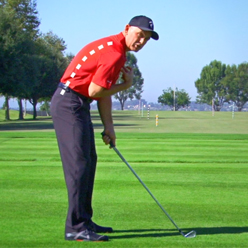
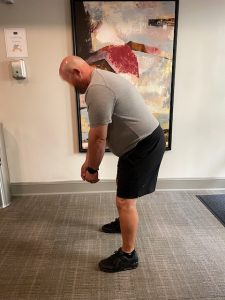
Amateur golfers tend to take their poor static posture along with them out to the golf course. This usually results in complaints about a loss of power, a lack of consistency, and low back pain.
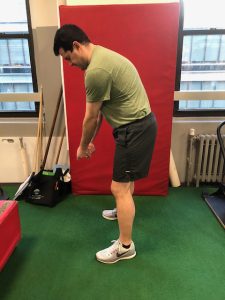
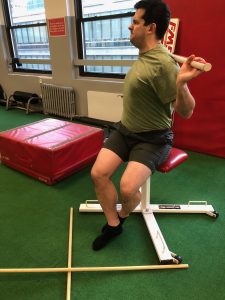
What are we looking at above?
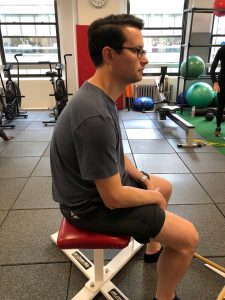
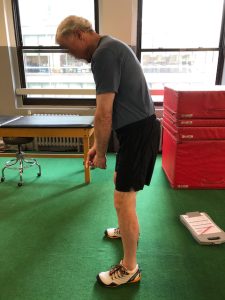
- In the first photo, I am assessing static mid-iron golf posture. As you can see, the upper back is very rounded, resembling the letter “C”. This is the most common address position I see.
- In the second photo, I am assessing the ability to rotate the upper back (thoracic spine) around a stable pelvis. Passing this test would mean the shoulders and spine can rotate 45 degrees or more, which is represented by the stick on the ground. Most PGA tour players exhibit 50 degrees of rotation or more. The player above has maybe, maybe 10!
Watch the assessment of one of golf’s rising stars, Aldrich Potgieter. The Seated Trunk Rotation Test is within the first two and 1/2 minutes. He exhibited 65 degrees to the right and 70 degrees to the left. Crazy amounts of mobility in the Thoracic Spine.
If you lose the ability to rotate through the upper spine, the lower back will really take a beating in your golf swing.

Gravity Sucks


While it’s true that gravity keeps our feet planted to the earth, it also pulls us back into it as we get older. But that doesn’t have to be the case.

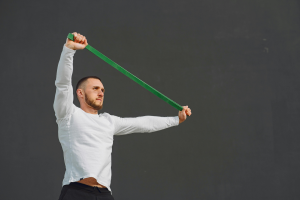
Not if you pay attention to your posture and work on it.

The only way to escape gravity is to become an astronaut.
The Side Effects of Poor Posture


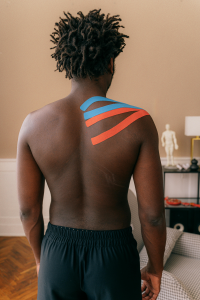
Poor posture increases stress on joints and the soft tissue surrounding them. Poor static posture, coupled with repetitive movement patterns, causes irritation and inflammation, putting stress on the neck, lower back, and shoulders, which can lead to pain and injury.

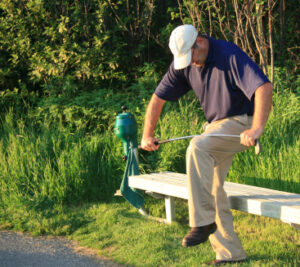
Poor posture reduces the rotational range of motion and limits your swing to only a fraction of its potential range of power and speed.
Brett’s Bottom Line:
As is stated in the Paul Chek quote above, “Posture isn’t something you can just think about and expect to change.” But improving upon your poor posture has to start with an awareness that it exists. That’s why I start every TPI Level 1 Screen with a golfer in they’re 5 iron static posture. Most of you have no idea what you look like at address, nor do you know why you look that way.
So, how will we fix poor posture? That’s what we will cover in PART 2 and PART 3 of this series. See you on the next page.