

Quick Rewind
In Part 1 of this series, there were three major points.
- MOBILITY – “The ability to get from place to place under one’s own power.”__Brett Cohen
- The main reason those of you reading this have lost your mobility is that you have stopped using your bodies the way they were designed to be used a long, long time ago. Even those of you who “exercise” all the time.
- Because the body is a series of interconnected parts, one part will impact the others. This impact can either be positive or negative.
- Mobility restrictions (a player’s inability to move at their best) are arguably the single biggest factor preventing a golfer from playing their best golf. Improve a player’s ability to move well, and not only will they perform better now, but longer into the future.
Where Do We Need Mobility?
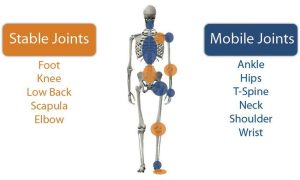
In the Joint-by-Joint theory developed by physical therapist Gray Cook and strength and conditioning coach Mike Boyle, we view the body as this alternating pattern of mobile joints and stable joints.
This philosophy of the body is what TPI Certified Professionals use when evaluating how the body functions and how that can affect the golf swing.

- “When you look at movement in general, mobility is at the center. Whether we are moving fast or slow, to do something efficiently we need an adequate ROM in our joints and good coordination.”__Neal Valera (founder of Stick Mobility)
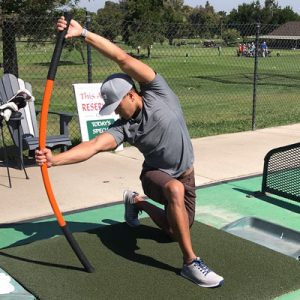
Understanding Your Body

If you think about the golf swing, would your brain prefer to use your mobile joints or your stable joints?
Golf is a rotary power sport; to be efficient at it, you need to be using your mobile joints.
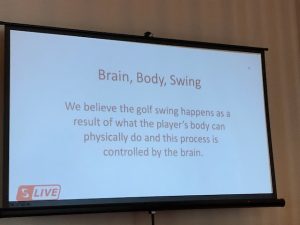
“We believe the golf swing happens as a result of what the player’s body can physically do, and this process is controlled by the brain.”__TPI Level 1 Lecture

In the backswing alone, you would want to see motion in your:
- Ankles
- Hips
- Thoracic Spine
- Shoulder
- Wrists
Those are your mobile joints.
When Things Go Wrong
Here’s the problem. Most of you, I’d say 99% of those I’ve tested over the past 16 years, from age 17 to 70+, have lost mobility in one or more of those mobile segments. Sometimes, in all of them.
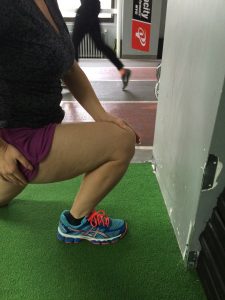 ankles
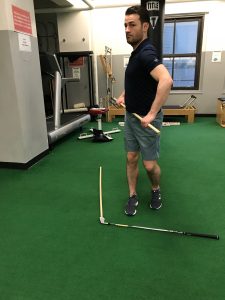 hips
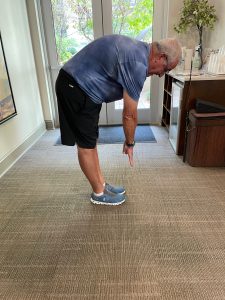 hips
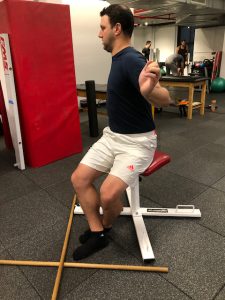 thoracic spine
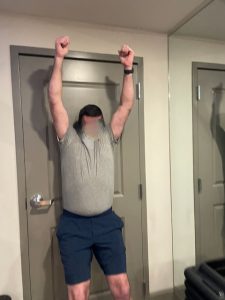 shoulders
When a joint loses its intended function, the joint above and/or below often compensates, eventually leading to pain and injury.

“The body works in an alternating pattern of stable joints connected by mobile joints. If that pattern is broken in any way, something bad is going to happen.”__Dr. Greg Rose

Here’s an example most of you can relate to, since nearly all of you tell me you struggle with golf-related low back pain.
- If your hips and/or the thoracic spine don’t rotate sufficiently, the body will look for rotation elsewhere. Like water running downstream, it will find the path of least resistance. So if you have less than adequate hip mobility and/or less than adequate thoracic (upper spine) mobility, your brain will simply substitute the lumbar spine for mobility.
- And the lumbar spine isn’t designed to rotate much. Remember, it’s a stable segment.

Anti-inflammatories are not a substitute for hip and thoracic spine mobility.
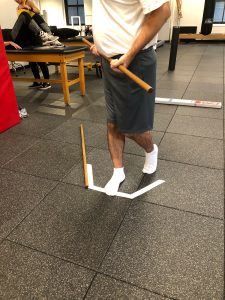
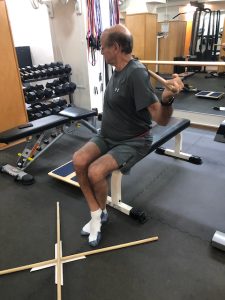
“All physical limitations lead to movement compensations, and when you add in enough frequency, volume, and load, it will lead to irritation, inflammation, pain, injury, and eventually surgery.” __Brett Cohen
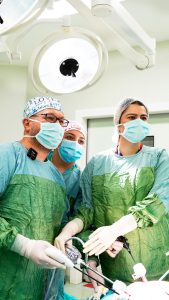
Surgery = Let’s Cut It Out!
I don’t know about you, but I plan to keep all my original parts until they put me in the ground.
You’re Not Alone! Even Really Good Golfers Struggle With Mobility. Check out this TPI Video
Speed and Distance start with Mobility. See you in PART 3