
Play With The Confidence of A Pro

I’m going to start this article off with a very simple concept. If you want to play with the confidence of a pro, then you need to start doing more of the things a pro does.

What Do Pros Do That You Don’t Do?
All PGA and LPGA players hold themselves to impossibly high standards. *Happy, but never satisfied.


Impossible standards are the hallmark of greatness. So, if you want to hold the trophy at the end of the tournament, you have to do what others aren’t willing to do.
Golf Is Hard

Don’t make it harder.
One thing professional golfers always do that amateur golfers rarely do is warm-up.
Why Should We Warm-Up?
Go to any professional athletic contest, and you will see those athletes warming up. A proper warm-up is something every great athlete does.
Not just by practicing the sport’s skills, but by getting their body and nervous system as prepared as possible before the game or contest begins.
I think most amateur golfers understand that they should do some kind of warm-up before beginning to play, but they simply don’t know where to begin, so they skip it altogether. This is a mistake!
Studies have shown that warming up and stretching improves physical performance and helps to prevent injuries. An effective warm-up increases your body temperature, removes movement restrictions, and uses movements that closely resemble the main activity to activate the nervous system.
I’m going to simplify the warm-up process for you by just giving you three steps.
This golf warm-up routine will:
- Address soft tissue quality, like a massage does. Elevate body/core temperature and increase blood flow.
- Improve mobility of the joints used in the golf swing, starting with local movement patterns to golf-specific movement patterns.
- Charge up and excite the nervous system to prepare the body for the demands of the activity to follow.

It’s dynamic, total-body, and it incorporates flexibility, mobility, stability, and balance. It’s appropriate for golfers of any level.
Step 1: Roll – Self-Myofascial Release


The first step in your Dynamic Warm-up for Golf routine is to address and improve your body’s tissue quality. We do that with a 5-minute routine using a massage stick, like the RAD ROD you see above. It’s one of the many wonderful self-massage and recovery tools Rad Roller Company makes.
I took the RAD Golf Mobility Course live in NYC back in 2018.

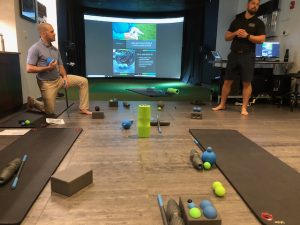
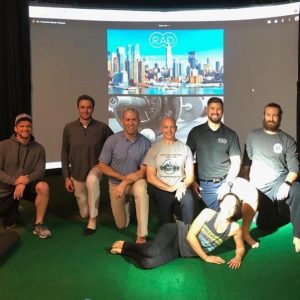
Guidelines for using the massage stick:
Apply firm pressure to each section of the body for approximately 30 seconds per segment using long, sweeping strokes.
There’s no hard and fast rule with time here. Your objective is to search for the “tender” areas (often referred to as trigger points, knots, or simply areas of increased tissue density) and destroy them.
This process, known as self-myofascial release, focuses on the neural and fascial systems in the body and concentrates on alleviating trigger points as well as areas of hyper-irritability.
Brett’s Bottom Line:
Roll each section of the body for approximately 30 seconds. Search for tender spots and roll them out until the discomfort diminishes, then move on to the next segment.
This improves tissue quality and extensibility, which will allow for more efficient stretching and improve joint range of motion.
Step 2: Stretch – Improve Tissue Readiness
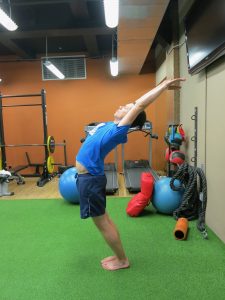
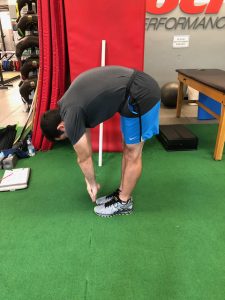
Unlike static stretches (where you’re just holding an individual muscle group in position for a predetermined amount of time), this short and simple warm-up takes the golfer from single joint movements to golf-specific movement patterns.
This dynamic total-body routine incorporates flexibility, mobility, stability, and balance. The only piece of equipment it requires is your driver.
The warm-up is appropriate for golfers of all levels and takes 4 minutes from beginning to end, leaving you feeling like you’ve already played through a few holes BEFORE you take your first swing. That’s The Objective!
Guidelines for the Dynamic Stretching Routine:
You don’t have to be thinking golf technique or swing here. This routine is about getting your body ready to take the club and drive it down the fairway.
Just use the body’s momentum to take each joint through the full available range of motion. We simply move into and out of each position repetitively until you loosen up.
Brett’s Bottom Line:
The more you practice this routine, the better you’ll become at it. Practicing it will help you improve golf performance and reduce your risk of injury. Perform 5 repetitions of each, moving smoothly in and out of each movement.
Step 3: Activate

Once we’ve improved muscle elasticity, muscle length, and joint mobility, we want to prepare the nervous system for activity. *Remember, golf is a rotational power sport!
It takes the average golf pro .25 seconds from the top of the backswing to impact. So to make that club move fast and get as much power to the ball, you need to “turn on” your fast-twitch muscle fibers.
To do this, we perform what’s known as activation training. This will get the nervous system fired up, which will improve power output. Increased power translates into faster, more explosive athletes and longer drives for the golfer.
A great tool for this is elastics or the Golf Forever Swing Trainer you see Scottie Sheffler using below.


And yes, I’m Golf Forever Certified and have been since 2024.

Below is just a sample of many exercises you could do before actually hitting balls.
Brett’s Bottom Line:
Activation exercises using bands and tubing are an excellent way to excite the nervous system without risk of injury and can be done in most any environment you can connect a band or tubing to.
Brett’s Bottom Line:

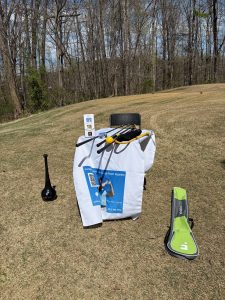
Back in the day, maybe a player like Tiger Woods would be in the trailer warming up, but it was nothing like today.


Today, every player who wants to play his or her best has to train for the game. There’s no way around it. If you don’t, you’ll be left behind.
This warm-up will make you feel better, move better, and play better! Guaranteed.
Want to hear more about the warm-up process? Just click the link below.

https://www.perkyllc.com/perky-collar-radio-show-podcast.html