Before physical training ever begins, I ask my golfers these questions as part of their Health History Intake:
- So you feel stiffness in your shoulders and neck?
- Do you feel stiff and blocked in your body?
- Are your movements restricted?
Invariably, the answer to these questions is almost always YES. And that makes sense, since the number one thing they tell me they need is “more flexibility for golf”.
Here are some recent examples of what I see from a website inquiry:
- “I am becoming increasingly stiff and weaker.”
- “I want to improve my golf-related mobility.”
- I’m an avid golfer who works a desk job.”
I have more, but you get the idea.
So what’s happening here? Well, to start, the average amateur golfer who is looking for help is still working a desk job and sitting on his butt for 12 – 14 hours a day.
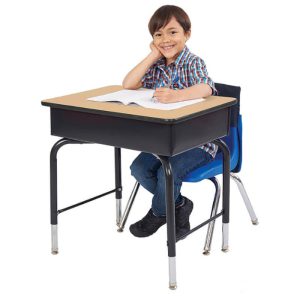


We start sitting at a desk around age 6 when we enter first grade, and in first-world countries, the majority of you are still sitting at a desk (just a larger one) for up to 7 more decades.
I have tested hundreds upon hundreds of golfers over the last 15+ years, and the one thing they have in common, besides a love for golf, is that they are all stiff! I have had men as young as 28 and as old as 78 exhibiting the same physical dysfunctions.
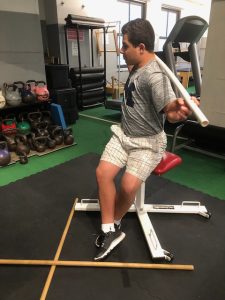
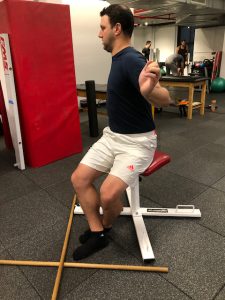
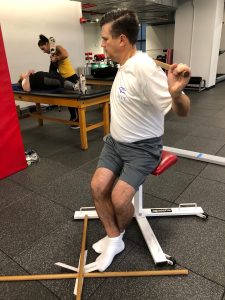
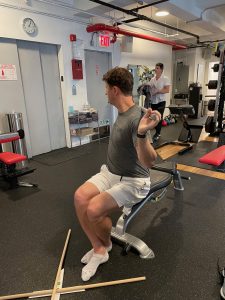
In case you’re not sure what we are looking at in the above screen, which is known as the Seated Trunk Rotation Test, the passing range on motion is a minimum of 45 degrees of thoracic (upper back) rotation, in both directions.
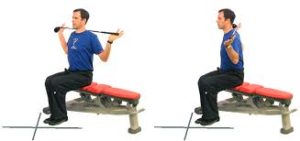
That would mean the stick on the golfer’s back needs to line up with the stick on the floor. As you can see, they are not even close! They range in age from 15 to 50.
How do you think that might affect their backswing?
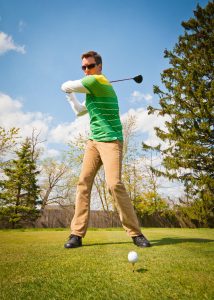
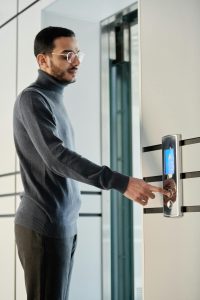
It turns a man into elevator man.
Not the best start for a golf swing. Especially if you want a more predictable, powerful, repeatable swing.
Move More Often

As obvious as this sounds, it’s necessary to state because most of you reading this aren’t moving nearly enough. For some reason, we think that as we get older, the less we tend to move. But it should be completely the opposite. We should be moving more. Albert Einstein said, “Life is like riding a bicycle. To keep your balance, you must keep moving.”
Get Regular Physical Activity
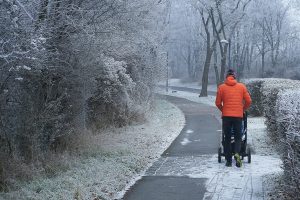
As a society, we simply don’t move enough! Most of us do not purposefully build physical activity into our day. Technology has robbed us of our natural inclination to move, and it seems to be getting worse and worse. (Heck, it’s why I have a job in the first place). Do you think there were any personal trainers 100 years ago? I don’t think so. To get from place to place, to mow the lawn, to do the laundry, to get food, we were moving.
If you want to be a healthy older person (or healthy person at any age), you need to move, to exercise. It’s that simple. Things that don’t move die. When a fish stops moving through the water, it suffocates and dies. When a stream stops running, the oxygen to the living organisms gets cut off, and everything in it chokes to death and dies.
“If you are not moving, you’re dying!”

Motion Is Lotion
When you don’t move enough, you experience what is known as ischemia. The medical term for a lack of blood flow or blood supply to any body part, causing a shortage of not only oxygen, but also a lack of blood flow to the soft tissues of the body (muscle, fascia, tendons, and ligaments).