But Brett, didn’t you tell me that golf is a rotational power sport? YES. It is. And if you want more consistency, more power, and to drastically reduce your chance of injury, you need to rotate, but it needs to happen from the right places.
If you watch this video of Justin James, it’s obvious there’s a lot of rotation going on. The rotation you see is primarily happening at the hips and thoracic spine (T-spine for short).
Unfortunately, most of you are going to struggle to have adequate mobility in both of these segments.
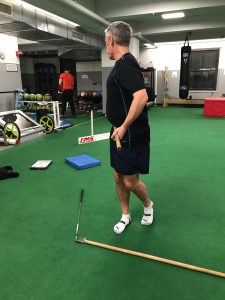
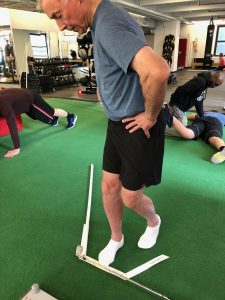
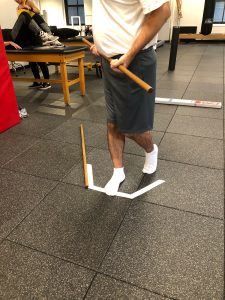
The photos above demonstrate a lack of trail hip internal rotation. This is necessary to “load” the trail hip.
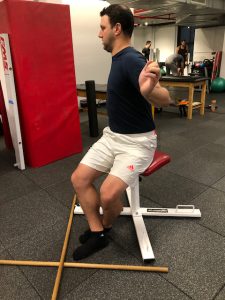
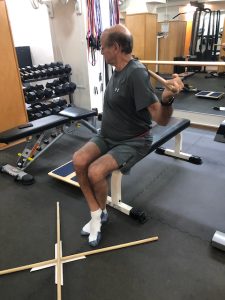
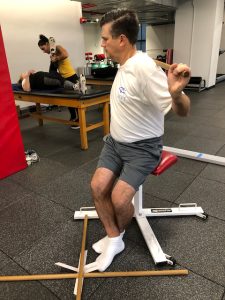
The photos above demonstrate a lack of trail-side thoracic rotation.
I want you to back and watch the Justin James video again. Watch how much he turns INTO his trail hip and how much upper body rotation he gets. Hey, I’m not saying I can help you move just like Justin James, but I am 100% certain I can improve your rotational capacity in both of these segments.
“Like so many others, I took regular golf lessons but resisted the notion that I was out of shape. I have been working with Brett for 3 years and I now understand what I believe to be true for virtually every golfer over 50, namely that we are physically unable to produce the swing that our pros are teaching us.”__Mark Cusick
Ok, now you understand where we need to rotate from. But what is this Resist Rotational Forces thing? Let me explain.
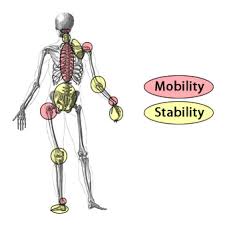
If you look at the body map above you will see that above and below each mobile segment or joint there is a stable segment or joint. It’s an alternating pattern. In order to create power you need to keep a stable segment still-stable, while the mobile segment moves around it.
- Mobility allows the generation of ELASTIC ENERGY between muscles, and that establishes a base for efficient power production.
- Stability is the ability of any system to remain unchanged or aligned in the presence of outside forces.
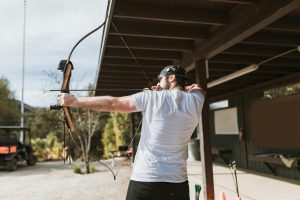
The ability to keep one part of the body secure while stretching and contracting adjacent segments allows us to generate speed and maintain consistent posture while doing so.
So if you want to create speed and have a powerful swing you need adequate mobility at a mobile segment and adequate stability (strength) at a stable segment (also known as Segmental Stability).
Let’s take this example. Imagine you have a pickle jar and you’re trying to get the lid off. It just won’t budge. This has happened to all of us.

You wouldn’t grab only the lid and turn the entire jar in one direction, of course not. You would hold the jar down with one hand (secure it on a table or counter) to create as much stability as possible, while you twisting the top in the opposite direction.
Stability Fundamentals
If we need mobility at the hips and t-spine, we need stability from the muscles that make up the gluteal complex and the muscles that support the spine (especially the lower back).
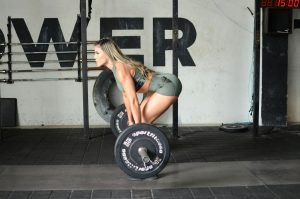
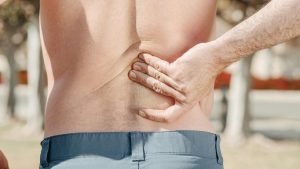
Your thighbone and pelvis are surrounded by more than 40 muscles in and around your hip, 40% of which cause either internal or external rotation. These muscles govern your hip’s ability to rotate around your legs and put muscles on stretch so they will store and ultimately release energy.
We also need stability from what is commonly referred to as “the core”. The core consists of the muscles of your torso primarily your abdominals and back. It’s the vital link between your hips and shoulders.
A great example of a core (resisted rotation or anti-rotation exercise is what’s known as the Pallof Press). See below.
In the example above, the athlete is on both knees and activating his gluteals and core to keep the spine erect while he pushes his hands away from his chest. Notice the triangle shape between his hands and his shoulders. This is the same position as holding a golf club.

The load coming from the cable stack is trying to bend and turn him in that direction. He is resisting rotational forces, just like that which is necessary at the beginning of a golf swing. If you do not stabilize the spine during the backswing you will SWAY or STAND UP, causing a loss of posture.
Brett’s Bottom Line:
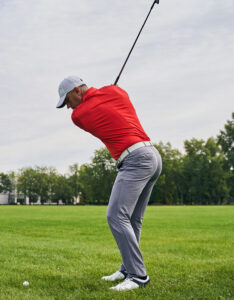
If your goal is to generate more rotation forces, first establish rotational capacity, THEN it is essential to work on the muscles that help you Resist Rotational Forces. With this combination of mobility and stability, you can begin to train your body to efficiently store and release energy which will not only help improve your golf game but will also protect your body and train it to withstand the rapid stretch loads associated with playing golf.
Need some help. That’s what I’m here for. Give me a call at (917) 596-8485 and we’ll have a chat about what you need and if I can help you.
Turning ordinary men into extraordinary golfers since 2010.