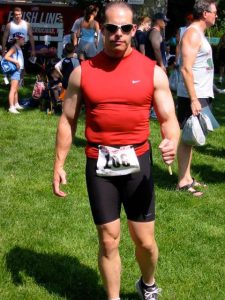

1977 High School Track Team
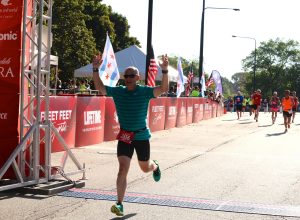
2014 Chicago Half-Marathon: 1:42:26/7:49/mile pace
Why Listen To Me….
I’ve been a runner for a long time now. I was on the high school track team as a sophomore and junior (albeit too slow to compete for points). Then I didn’t really run regularly again until some 22 years later. Since 1999, I’ve run more than 600 road races, remained injury-free, I still have all my original parts, and regularly place 1st – 3rd in local 5K races.

Like most neophyte road runners, I didn’t know a thing about training, periodization, race preparation, and recovery strategies.

I just tied my shoes and went out the door, looking to simply accumulate miles. To most runners, it’s all about the miles. But road running, at least successful road running, is about so much more than just the miles.

TRAIN
The average run coach tells you the following three things:
- How Far
- How Fast
- How Often
But training for road races, especially longer ones, like 10K to Marathon distance, requires much more than that.
Understand Your Risk
The first thing endurance athletes should do, but don’t, is to do a physical screen to determine what their injury risk potential is before embarking on an endurance training program.
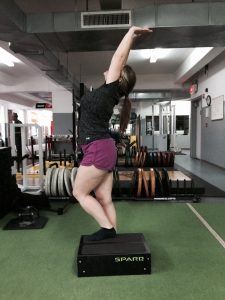 (How well can you extend your hips?)
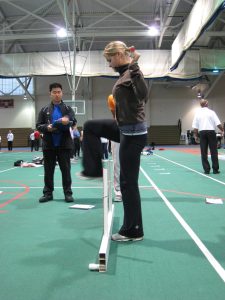 (How well can you flex your hips, and what does your single-leg balance look like?)
These are essential patterns necessary for injury-free running.
A 2009 runnersworld.com poll revealed that 66 percent of respondents had suffered an injury.


That’s 2 out of every 3 runners! Yet to become a runner, all you need to do is tie your shoes and put one foot in front of the other. No screening necessary!
The sad fact is that most people who take up running to get fit aren’t even fit enough to run. They don’t possess the physical prerequisites (joint mobility, muscular flexibility, muscular stability, and strength) that are needed to survive the repetitive pounding this sport dishes out.
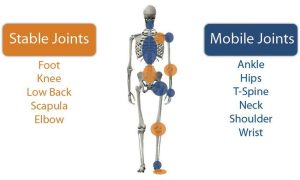
Canadian Physiotherapist Diane Lee said it best, “You can’t run to get fit, you need to be fit to run.”
The best way to reduce your injury risk potential is to use a physical screening process that helps to identify how susceptible you are to injury in the first place. Using a movement screen helps to determine weak links in an athlete’s body by gauging and assessing human movement patterns: simply, watching how well you move. The screen becomes a predictor of future injuries as well as a confirmation of current complaints.
Know Your Limits

Christopher McDougall, author of Born to Run, said, “Talk to a runner, I guarantee that within 30 seconds the conversation will turn to injury.”
With all of running’s great physiological benefits, stronger bones, stronger muscles, and improved cardiovascular health–it’s important not to overlook the negative impact running can have on your body. With each step we take, our body is subject to the shock of impact of three times our body weight. This can take its toll on someone who is not ‘born to run’ and may aggravate trouble spots or weak links, and lead to injury. This is where many runners are their own worst enemies.
The most common running injuries are due to a combination of physical asymmetries coupled with overuse. So one of the best ways to reduce your injury risk potential is to limit how much stress you place on your body by only running one race event in any given week. Yet, there are organized events that encourage runners to run multiple races within the same weekend, putting their bodies at greater risk of injury, just to earn a different medal or special T-shirt.


Even Road Runners Magazine’s former Run Fest, held in Bethlehem, PA, would do this. Right after, the local hospital did a lecture on how to reduce running-related injuries! (LOOK FOR DOUBLE PLAY OR TRIPLE PLAY in the link above), appropriately sponsored by local orthopedic surgeons.

Every runner has an injury threshold, the point at which any additional stress on the system, whether it’s in volume (miles run) or intensity (speed work or races), will get you injured. There probably aren’t any Tarahumara Indians reading this. Just a lot of regular runners like me and you.
Unfortunately, we are not all as injury-resistant as the great Dean Karnazes! Don’t get me wrong, I love a good race as much as any runner and run over 20 every year, but running multiple events on the same day or same weekend isn’t just Goofy, or Dopey, it’s Stupid!
Periodize Your Training

Any runner who has followed a program to train for a half or full marathon has followed a plan strength and conditioning professionals call periodization. Periodization simply means a method of exercise progression that allows an athlete to peak at the necessary time, usually at the point of competition.
Most periodization plans for runners are a combination of linear and undulating.
- Linear periodization is a system that gradually adds volume over time.
- Undulating periodization usually consists of three weeks of increased volume followed by an unload week or decrease in volume (miles).
Training for a half or whole marathon is as grueling mentally as it is physically, and completion of an event of this magnitude should be followed by a period of rest sufficient enough to allow your body and mind to recover from the intense training.
Once you have recovered, it is time to implement an off-season strength training and running program. But many runners are locked into the same running routine and follow a half-marathon or marathon event with another just like before the sweat dries. This is not only a recipe for reduced performance, but it will bring you one step closer to an orthopedic surgeon’s knife.
As a former NY’er and someone who has run the NYC Marathon (4 times) as well as Chicago, I have known many a runner who signs up for both with barely 3 weeks between them. This is a recipe for disaster. A professional marathoner will typically not run more than 3 marathons a year. There’s a reason for that!

I recommend creating an off-season (time away from all that endurance training) to work on your physical weaknesses, using a progressive resistance training program with an emphasis on addressing your deficits in hip and core strength. Getting strong before beginning an endurance training program will take your running to the next level and dramatically decrease your injury risk potential.
“Before each training cycle, I add one thing to focus on that will benefit my running, like doing strength training. This helps me to improve without risking injury.”-Clara Grandt-2011 Boston Marathon in 2:29:52 at age 24
See you in PART 2