
Another quick rewind
In Part 1 of this series, I told you that we lose mobility over time because we stop using our bodies as they were designed, often at a very young age. Many of you struggle to perform the 7 Primal Movement Patterns efficiently.
- Squat: Lowering your hips from a high center of gravity with a more upright spine angle.
- Bend (Hinge): Lowering your center of gravity primarily through hip hinging.
- Lunge: Stepping and dropping vertically into a single-leg or split stance.
- Push: Moving an external resistance or your body away from a load.
- Pull: Drawing a load or your body toward your center line.
- Twist: Rotating the ribcage relative to the pelvis.
- Gait: The integration of walking, jogging, or running by combining multiple patterns like pulling, lunging, and twisting
In Part 2 of this series, I told you about the Joint-By-Joint Approach and that golfers needed mobility at the following segments:
- Ankles
- Hips
- Thoracic Spine
- Shoulder
- Wrists
In Part 3, I gave you my 4-step formula for improving fascial health.
- Hydration
- Maniuplation
- Elongation
- Integration
In Part 4, I will give you my strategies for improving Joint-Based Mobility Restrictions
Joint-Based Restrictions
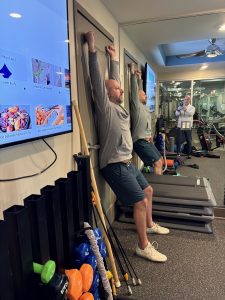
Let’s say you struggle lifting your arms overhead.
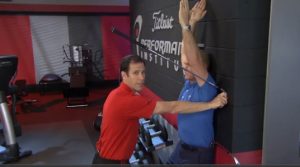
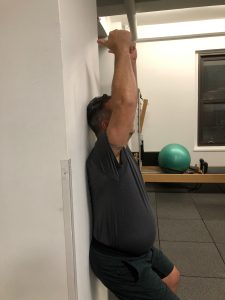
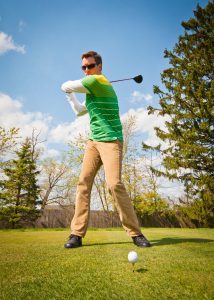
If you do, and you try to get the arms up and wide to create some clubhead speed, you will very likely stand up and come out of posture while doing so. That leads to a host of problems the brain has to figure out as you transition into impact. (Complaining about consistency? )
Since the Latissimus Dorsi muscle is the only muscle connecting the top of your pelvis to the upper arm bone, we start there.

Step 1: Roll the Tissue – We place a foam roller at the widest part of the back, below the armpit level, and pivot around it. This may produce a slight sharpness when you find the tighter spots.

Step 2: Stretch The Tissue
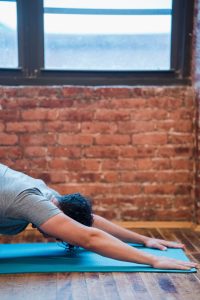

Step 3: Distract The Joint

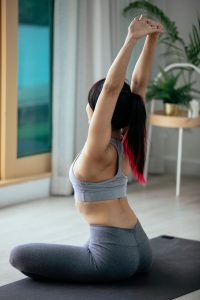
What does joint-distraction mean?
- Distraction is the key to opening up joints. We can use tools such as strength bands or TRX Suspension Trainers to help open up space in the joint. OR
- Methods of myofascial stretching, such as ELDOA.
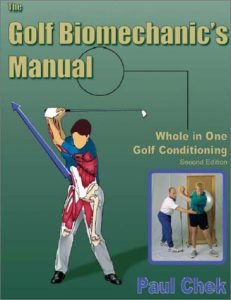
The intention of a joint distraction is the following, and I know this is a mouthful, but I have it memorized since 2002 when I took my C.H.E.K Golf Biomechanics certification: to put the joint in its “Optimal Instantaneous Axis of Rotation”.
Step 4: Load The Joint
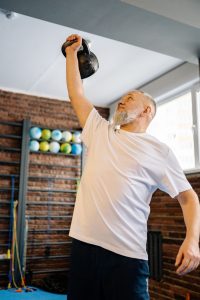
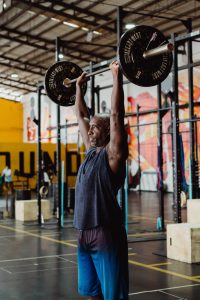
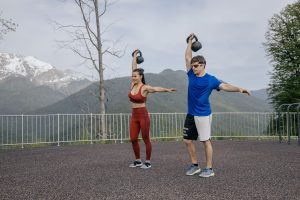
Once we have improved the joint’s position, we can now add load so that the surrounding muscles (stabilizers) act to preserve that position in functional patterns.
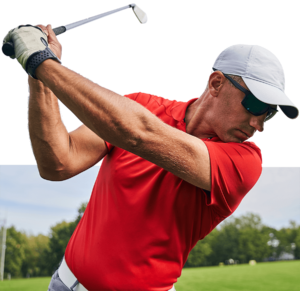
Optimal range of motion is a biomechanical prerequisite for an efficient golf swing.
BEFORE. 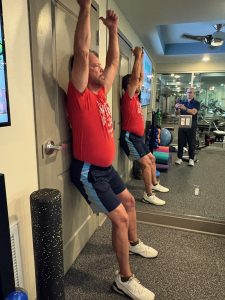
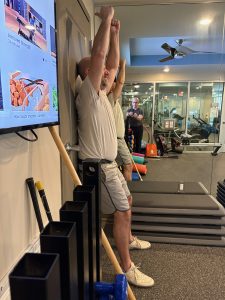
AFTER. 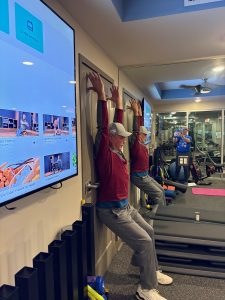
Would you like some help with your mobility?
Just send me a note in the intake box and say, “MOVE BETTER”. I’ll know what you mean.

Brett