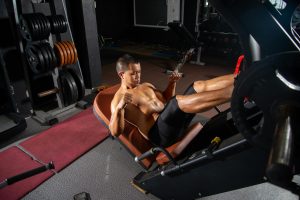
BAD VERY BAD VERY VERY BAD
What is Strength?
Strength is the amount of work or force that can be produced by a muscle or group of muscles (regardless of time).
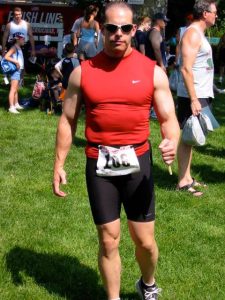
Take this man below. He looks STRONG to me! Is the strength he possesses applicable to golf? Mmmm, probably not!
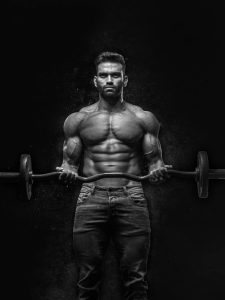
Why is this kind of strength training bad for golfers? For strength to be beneficial in a sport or physical activity, it needs to be specific to the movements involved in that sport or activity and the speed at which that force must be exerted.
Let’s start with this premise. Golf is a rotational power sport.
The golf swing starts with your feet connected to the ground and ends with the club connected to your hands. The power flow starts in the lower body and continues through the trunk, the shoulder/arm, and then the club into the ball. This is known as the downswing Kinematic Sequence. The energy flows from the ground up, just like an open fire hydrant.
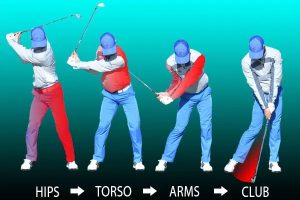
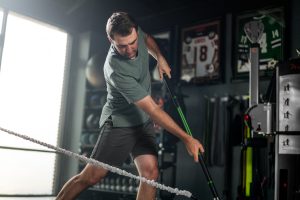

Check out Golf Digest Top Instructor and TPI Instructor Mark Blackburn explains how this works in the simplest way.
Movements That Matter
If you’re near my age (63 at the time of this writing), you grew up with the legendary bodybuilders of the 1970s. Arnold Schwarzenegger, Frank Zane, Lou Ferrigno. These guys looked like Greek Gods! These guys still used ‘free-weights’, doing some traditional strength training; squats, deadlifts, pull-ups, bench presses. Not long after that, the tide turned to what’s known as ‘fixed-axis’ machines.
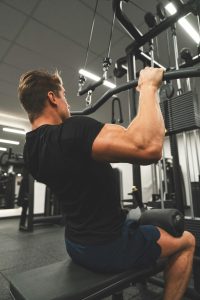
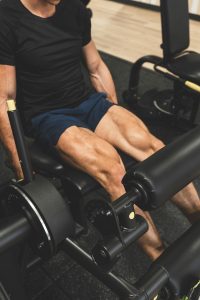
This is an example of a fixed-axis machine.
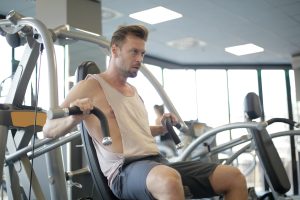
So what’s the problem? Well as you can see, first off the man is seated. You don’t play golf seated. Secondly, this is known as an isolation exercise simply to increase your pecs’ strength and possibly size. The butt is on a seat and your spine (your core) is being supported by the back pad. Great exercise if you’re a bodybuilder. Not if you’re a golfer or any other athlete for that matter. This goes for any other machine in the gym. Many training programs are based on the one-dimensional movements of bodybuilding, exercises designed solely to build a targeted muscle. If you’re seated, there is no functional carry-over to life or sport.
The worst type of strength training for the average amateur athlete who sits at a desk most of the day and lacks rotational capabilities in the hips, thoracic spine, and neck is seated machine training.

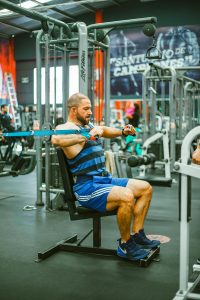 (how will this help you play golf better)?
“Exercise machines are simply a desk chair without wheels and a stack of weights behind them.”__Brett Cohen
“Any time a machine guides the load using a fixed, or even semi-fixed, axis of motion, there is a reduction in the need to recruit the body’s own stabilizers.”–Movement That Matters-Paul Chek
Screening For Golfers
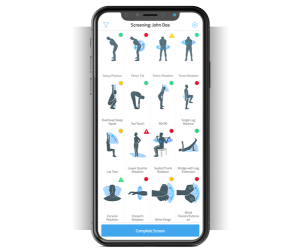
The initial evaluation begins with what TPI calls the level 1 screen. I’ve described this in many other articles so if you want to read more click this link.
This screen looks at flexibility, mobility, stability, balance, and coordination patterns as they relate to the golf swing. Your Game Starts Here! Literally. It weeds out the physical restrictions you may have that are negatively affecting your golf game. If you do not possess adequate amounts of those physical qualities, more strength is not going to make you a better golfer! PERIOD!
The Level 2 screen looks at strength, power, speed, and cardiovascular efficiency.
How strong do you need to be to play golf?
We need a system to determine how strong you need to be to play golf. At TPI we have 4 strength tests:
- Push
- Pull
- Lower Body (Split Squat)
- Grip
All those 4 components will make up the strength tests and will determine if that player has adequate strength, for their body size, to hit the golf ball.
Take a look at this video to see a sample of the power and strength tests we do on golfers. How well do you think you’d do?
Brett’s Bottom Line:
We need to turn our focus away from just looking better and move toward strength training protocols that also help you perform better in all areas of your life. Not just a body that looks good but one that is capable of thriving the tasks of everyday life and sports.
In PART 2 we move from BAD to BETTER. See you there.